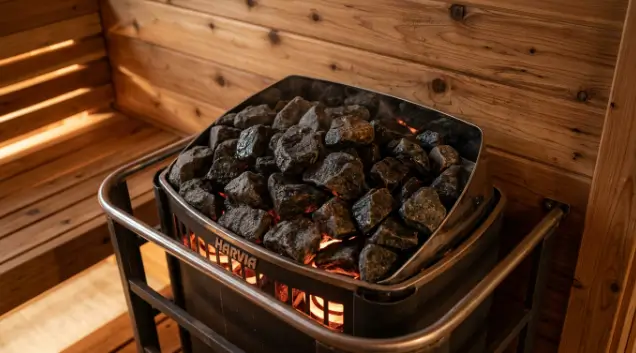
A sauna heater a whole household will actually use week after week usually means sizing up rather than down: a 6 kW to 9 kW unit for a small cabin built for three or four people, fast enough recovery between sessions to handle back-to-back use, and a guard rail and controls simple enough that every adult in the house can run it without a manual. Undersizing for the sake of a lower price tag is the most common reason a household sauna gets used twice and then sits idle.
How does household size change the heater size you need?
A single person cabin can get by on a 4.5 kW heater in a tight footprint, but a household sharing the space needs both a larger room and a heater sized to keep up. A cabin built for three to four people generally runs 150 to 220 cubic feet, and a heater in that range needs 6 kW to 9 kW to reach and hold temperature without running constantly. The bigger factor for a household, more than for a single user, is recovery time: how fast the room gets back to temperature after the door has been opened a few times as people rotate in and out. A properly sized heater for the room recovers in well under an hour, while an undersized one can leave the room noticeably cooler for the next person.
What features actually get used by a whole family, not just one person?
Simple, legible controls matter more in a shared household than in a single-user setup, since not everyone in the house wants to learn a complicated interface to start a session. A basic digital controller with a couple of saved presets, one shorter and cooler, one longer and hotter, covers most household variation without anyone needing to recalculate settings each time. A guard rail is also more important with household use than solo use, simply because more people, including possibly kids, are moving in and out of a small space near a hot surface.
How do different heat preferences get resolved in one shared cabin?
Since a shared sauna only has one room temperature at a time, households typically solve preference differences by scheduling rather than by adjusting mid-session. A common pattern is a shorter, moderate session earlier in the evening for anyone less heat-tolerant, followed by a longer, hotter session later for whoever wants more intensity. This is less of a technical problem than a household habit, and it tends to sort itself out within the first few weeks of ownership once everyone knows roughly what they prefer.
What should a household actually compare before buying?
Beyond kW rating, a household buyer should compare recovery time claims, stone capacity (more stones generally means steadier heat retention through a session), and whether the package includes a guard rail sized for the specific cabin dimensions. Comparing a few options side by side through the team at SweatDecks before settling on a specific package is a reasonable way to line up kW rating, stone capacity, and guard rail specs against your actual room size and household headcount.
Does daily household use wear out a heater faster?
Heaters built for regular residential use are designed for repeated heat cycling, so a family running the sauna most days of the week is well within normal use for a properly sized unit. The parts that see the most wear are the stones, which crack from repeated thermal shock over months of regular water splashing, and heating elements, which have a rated lifespan that manufacturers typically publish. Neither wears out meaningfully faster from household-level daily use compared to a single person using it a few times a week, as long as the heater was sized correctly for the room in the first place.
Is a household sauna habit actually worth the investment?
A Mayo Clinic Proceedings review of the sauna literature found regular use, generally several sessions a week over years, is associated with favorable cardiovascular and general wellness markers, and a 2023 follow-up review from the same journal found combining regular sauna use with other healthy lifestyle habits may add further benefit beyond sauna use alone. An American Journal of Physiology paper on heat and cold effects reached broadly consistent conclusions about regular Finnish-style sauna bathing. These are association findings across cohort studies, not proof that sauna time alone changes outcomes, but a household that actually uses the sauna regularly, rather than a household that owns one and rarely turns it on, is the group most likely to see any of these associated benefits play out.
What is the real cost difference between household-sized and single-user heaters?
Stepping up from a 4.5 kW single-user heater to a 6 kW or 9 kW household-capable unit typically adds a modest amount to the sticker price relative to the total cost of the cabin, stones, and installation. Given that undersizing is the single biggest reason a household sauna stops getting used, most buyers find the upgrade to a household-appropriate size worth it rather than saving on the heater and losing the whole investment to disuse a few months in.
Frequently Asked Questions
What sauna heater size fits a family of four in a small cabin?
A cabin sized for three to four people, generally 150 to 220 cubic feet, usually needs a heater in the 6 kW to 9 kW range. Larger households often prefer 9 kW for faster recovery time between back-to-back sessions.
Can different family members set different sauna temperatures?
Not simultaneously in a shared cabin, since there is one heater and one room temperature. Many households solve this by scheduling shorter, cooler sessions for less heat-tolerant members and longer, hotter ones separately.
Is a digital controller worth it for a household sauna heater?
For a heater used by multiple people with different preferences, a digital controller with presets makes it easier to save a few standard temperature and time combinations rather than adjusting manually every session.
How often can a family realistically use a small sauna heater?
Most household heaters can run daily without issue, since they are built for repeated heat cycling. Recovery time between sessions is short, typically under an hour, for a properly sized 6 kW to 9 kW unit.
Do kids need special precautions around a sauna heater?
A guard rail around the heater is the main physical safeguard, and sessions for children are typically shorter and at lower temperatures than for adults. Direct adult supervision is standard practice for any household with kids using the sauna.
References
- Cardiovascular and Other Health Benefits of Sauna Bathing: A Review of the Evidence, Mayo Clinic Proceedings, 2018
- Does the Combination of Finnish Sauna Bathing and Other Lifestyle Factors Confer Additional Health Benefits? A Review of the Evidence, Mayo Clinic Proceedings, 2023
- Effects of heat and cold on health, with special reference to Finnish sauna bathing, American Journal of Physiology, 2018
- Saunas and your health, Harvard Health Publishing
By Angela Bricker